
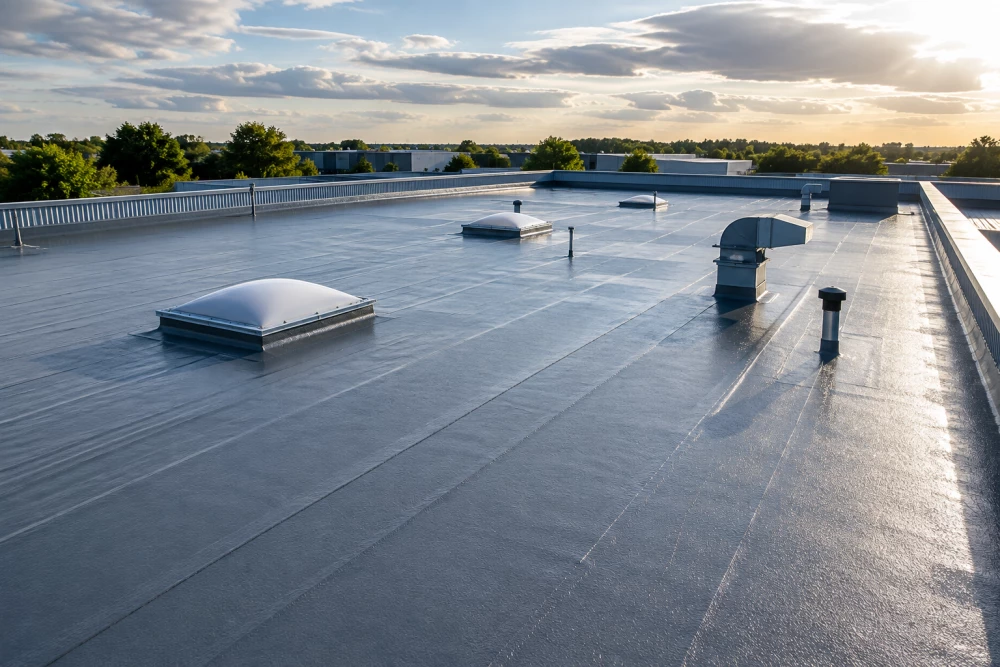
GRP Roofing in Melton Mowbray
Get in TouchGRP roofing uses resin and glass-fibre reinforcement to create a continuous waterproof covering across a roof.
Also known as fibreglass roofing, GRP systems are commonly used on flat and low-pitched roofs where a rigid, fully bonded finish is suitable.
We install GRP roofing in Melton Mowbray for new roofs, replacement flat roofs and refurbishment projects.
What Is GRP Roofing?
GRP stands for Glass Reinforced Polyester and is commonly referred to as fibreglass roofing.
The roofing system combines glass-fibre reinforcement with liquid polyester resin. Once applied and cured, these components form a rigid reinforced laminate.
A compatible topcoat is then applied according to the selected system to complete the exposed roof finish.
The basic relationship is:
Roof deck → resin → glass-fibre reinforcement → cured GRP laminate → topcoat
This distinguishes traditional GRP roofing from other liquid waterproofing systems that use different resins and reinforcement methods.
Fibreglass Flat Roofing Melton Mowbray
Flat roofs are one of the main applications for GRP.
The system can form a continuous waterproof covering across the main roof area while being detailed around its edges and penetrations.
GRP roofing can be considered for:
House extensions
Garage roofs
Dormer roofs
Porches
Commercial flat roofs
Small industrial roofs
Outbuildings
Canopies
The roof construction and proposed GRP system should be considered together rather than applying fibreglass indiscriminately to any existing surface.
New GRP Flat Roofs
GRP is particularly relevant when constructing a new flat roof with a suitable timber deck.
The deck provides the surface onto which the GRP laminate is formed.
A typical new installation involves preparing the deck, installing perimeter trims, laminating the glass-fibre reinforcement with resin and completing the system with its specified topcoat.
Manufacturer requirements should determine the precise materials, reinforcement and application method.
Request a Fibreglass Roofing Quote
GRP Roofing Over OSB
OSB decking is commonly used beneath site-applied GRP roofing systems.
The boards need to be suitable for the selected roofing specification and correctly installed as part of the roof construction.
Before laminating begins, the substrate needs to be appropriately dry, clean and stable.
Moisture or contamination can interfere with the relationship between the GRP system and its substrate.
The precise decking requirements should therefore follow the specification of the GRP manufacturer being installed.
How Is a GRP Roof Installed?
Installation varies between products, but a GRP roofing project generally progresses through several distinct stages.
1. Roof Deck
The roof deck is installed or assessed to establish a suitable substrate.
2. Roof Trims
Compatible trims are fitted around roof edges and other required details.
3. Resin and Reinforcement
Glass-fibre reinforcement is combined with catalysed resin to create the laminate.
4. Detailing
Edges, upstands, outlets and penetrations are incorporated into the waterproofing system.
5. Curing
The laminate is allowed to cure according to the system and environmental conditions.
6. Topcoat
The specified finish is applied to complete the exposed GRP roof.
Installation conditions and curing requirements should always follow the particular manufacturer's instructions.
Seamless GRP Roof Waterproofing
GRP is formed directly on the roof rather than being installed as large pre-manufactured sheets.
Once completed, the laminate provides a continuous waterproof covering across the treated area.
This can reduce reliance on the field seams associated with sheet-based membranes.
The roof still contains important interfaces at edges, outlets, upstands and penetrations, so these details remain critical parts of the waterproofing installation.
GRP Roofing for Extensions Melton Mowbray
House extensions frequently use flat or low-pitched roof constructions.
GRP can provide the external waterproofing layer where it is compatible with the proposed roof build-up.
Rooflights, parapets and other architectural details can be incorporated into the GRP installation using details appropriate to the selected system.
The complete roof design should also consider insulation, drainage and the supporting structure rather than treating the GRP covering as the only component of the roof.
GRP Garage Roofs
Garages are another common application for fibreglass roofing.
GRP can be installed as part of a new garage roof or used when an existing covering is being replaced and an appropriate deck is provided.
Detached garages can have relatively straightforward roof shapes, while garages attached to another building may contain wall junctions, outlets and other details requiring careful waterproofing.
The condition of the existing roof should be established before deciding whether it can be refurbished or needs to be stripped back.
GRP Roof Edge Trims
Perimeter details help form the finished edges of a fibreglass roof.
GRP roofing systems can use purpose-made trims for different roof conditions.
These can include details for:
Drip edges
Raised edges
Wall junctions
Internal corners
External corners
Expansion details
The required trims depend on the roof geometry and selected system.
They should be installed and incorporated into the laminate according to the manufacturer's specification.
GRP Roofing Around Rooflights
Rooflights interrupt the main roof area and create additional waterproofing interfaces.
The GRP system needs to be detailed around the kerb or upstand rather than simply terminating at its edge.
This allows the waterproofing to connect the main roof surface with the raised detail.
The same principle applies to other roof penetrations where the membrane changes direction.
GRP Roofing Around Upstands and Penetrations
Flat roofs can contain pipes, vents, outlets, parapets and other details.
GRP can be formed around suitable details using the reinforcement and resin system.
Particular attention should be given to:
Main roof → upstand
Roof deck → wall junction
Membrane → outlet
Roof surface → pipe penetration
GRP laminate → perimeter trim
These interfaces are part of the waterproofing system and need to be completed according to the specified GRP detail.
GRP Roof Replacement Melton Mowbray
An existing flat roof may eventually require replacement because of deterioration, repeated leaks or changes to the wider roof construction.
The old covering can be removed so the structure and roof deck beneath it can be assessed.
Damaged or unsuitable decking should not simply be concealed beneath a new GRP system.
Once a suitable substrate has been established, the replacement fibreglass roof can be installed as part of the new build-up.
Can GRP Be Installed Over an Existing Roof?
This depends on the GRP system and existing roof.
Traditional fibreglass systems are commonly associated with suitable timber decking, while some modern reinforced liquid systems are specifically designed for overlay applications.
Existing coverings should therefore not automatically be coated with a standard GRP system.
The existing substrate, compatibility and manufacturer's approved applications should be checked first.
Where an overlay system is appropriate, preparation and primers may also differ according to the material being covered.
GRP Roof Repairs
Local damage does not necessarily mean that an entire GRP roof needs replacing.
The condition and extent of the problem should be assessed first.
Potential issues can include:
Local cracks
Impact damage
Failed details
Damage around penetrations
Deteriorated topcoat
Previous unsuccessful repairs
Compatible repair materials and preparation methods should be used according to the existing GRP system where this can be identified.
Widespread failure or problems with the roof deck can require more extensive refurbishment.
GRP Roofing and Roof Drainage
GRP provides the waterproof covering, but the roof still needs an effective drainage strategy.
Falls direct rainwater towards outlets or gutters.
The roof design should therefore consider:
Rainfall → roof falls → outlets/gutters → drainage
Low areas where water repeatedly accumulates should be investigated rather than assuming the waterproofing membrane alone resolves the underlying drainage issue.
Outlets also need to be properly integrated into the GRP waterproofing.
GRP Roofs and Installation Conditions
Site-applied GRP is sensitive to the conditions in which it is installed.
Temperature, rain and moisture within the substrate can affect application and curing.
The roof deck should meet the conditions specified by the system manufacturer before work begins.
Weather forecasts are therefore particularly important when planning GRP roofing work because the laminate and associated finishes need suitable conditions during installation and curing.
GRP Roofing for Commercial Buildings Melton Mowbray
GRP is not limited to residential extensions and garages.
Suitable systems can also be used on commercial roofs where their characteristics correspond with the roof design.
Applications can include smaller commercial flat roofs, entrance canopies and other roof areas containing details suited to a reinforced liquid-applied system.
For larger or more complex commercial roofs, alternative liquid waterproofing technologies may also be considered depending on the substrate, movement and refurbishment requirements.
GRP Roofing vs Other Liquid Roofing
GRP is one category within the wider liquid-applied roofing market.
Other liquid waterproofing technologies use different resin chemistries and can have different characteristics.
This means:
GRP roofing → glass reinforcement + polyester resin → rigid reinforced laminate
while other:
Liquid roofing → alternative resin technology → system-specific membrane
The appropriate option depends on the roof construction, substrate and project requirements.
Choosing a GRP Roofing System
A GRP specification should be based on the complete roof rather than simply its size.
Important considerations include:
Roof construction
Deck material
Existing roof condition
Roof falls
Drainage
Rooflights
Upstands
Penetrations
Perimeter details
Expected access
Installation conditions
Manufacturer requirements
These factors determine whether GRP is appropriate and how the system should be detailed.
GRP Roofing Contractors Melton Mowbray
We provide GRP roofing installation throughout Melton Mowbray for flat roofs, extensions, garages and suitable commercial properties.
Projects can include new fibreglass roofs, replacement GRP roofing, roof preparation, detailing around rooflights and penetrations, edge trims and local GRP refurbishment.
Send us photographs of the roof, its approximate dimensions and details of the existing covering or proposed roof construction. This helps establish whether GRP is suitable and what work is likely to be required.
We cover Melton Mowbray (Leicestershire)