
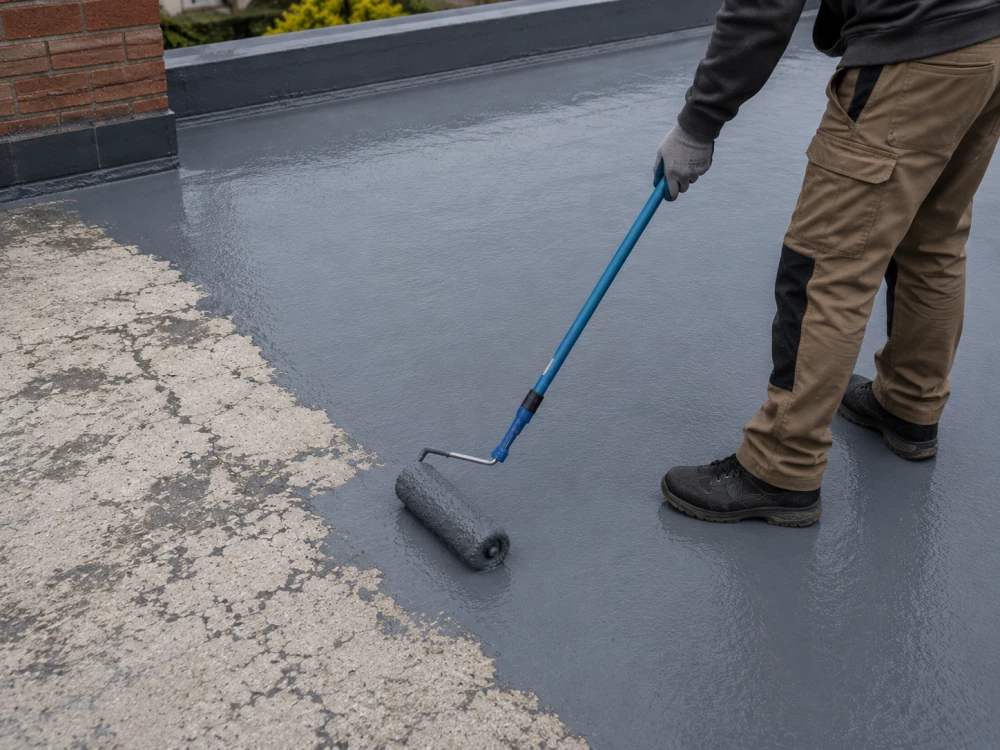
Liquid Roof Repair in Leicestershire
Get in TouchLiquid roof repair can restore localised areas of damaged or deteriorated waterproofing without automatically replacing the entire roof.
The correct repair depends on what has failed. Water ingress may originate from the main membrane, an upstand, outlet, penetration, joint or another roof detail, so identifying the defect is an important part of the repair process.
We provide liquid roof repair in Leicestershire for commercial, industrial and residential flat roofs.
Get a Liquid Roof Repair Quote
Repairing a Leaking Liquid Roof
Finding water inside a building does not necessarily identify where the external roof has failed.
Water can travel through the roof construction before becoming visible internally.
A repair should therefore start by considering the wider roof rather than simply applying liquid material directly above the visible leak.
The process is:
Water ingress → investigation → defect identified → preparation → compatible repair → restored waterproofing
Where the defect is isolated, a local liquid repair may be appropriate.
Where deterioration is widespread, broader refurbishment may need to be considered.
What Problems Can Liquid Roof Repairs Address?
Liquid waterproofing systems can be used to repair a range of roof defects where the existing construction provides a suitable basis for the work.
Typical problems include:
Local membrane damage
Cracks and splits
Failed previous repairs
Deteriorated roof details
Problems around penetrations
Damaged upstands
Defects around rooflights
Failed outlet details
Localised deterioration
Areas of exposed substrate
Defects within compatible existing waterproofing
The cause and extent of the problem should be established before deciding how much of the roof needs treatment.
Flat Roof Leak Repair Leicestershire
Flat roofs contain numerous points where different materials and details meet.
Waterproofing failures can develop within the main roof covering, but leaks can also originate around edges, penetrations and drainage points.
An inspection can consider the condition of:
Main membrane → field area
Rooflight → kerb and upstand
Pipe → penetration detail
Parapet → termination
Roof → outlet
Plant → support detail
This helps narrow down the likely source before repair work begins.
Localised Liquid Roof Repairs
Not every waterproofing defect requires a complete roof refurbishment.
If the surrounding membrane remains in serviceable condition and the problem is confined to a small area, a local repair can sometimes restore continuity.
The affected section needs to be prepared and the repair material must be compatible with the existing waterproofing.
Depending on the system, reinforcement may also form part of the repair.
Simply brushing an unidentified liquid coating over the area is not the same as completing a compatible waterproofing repair.
Repairing Cracks and Splits
Cracks and splits can appear for several reasons.
The visible opening may be associated with movement within the substrate, deterioration of the waterproofing or failure at an interface between materials.
Before repairing the surface, it is useful to establish what is happening underneath it.
A repair system can then be selected that is appropriate for the substrate and expected movement.
Where reinforcement forms part of the specified liquid system, it can be incorporated across the repaired area according to the manufacturer's requirements.
Repairing Roof Details
Detailed areas often contain several changes in direction and different materials within a relatively small space.
These interfaces can include:
Internal corners
External corners
Upstands
Parapets
Kerbs
Pipe penetrations
Rooflight details
Plant supports
Outlets
Liquid-applied waterproofing can be useful for repairs because it can follow the shape of these details and connect them back into the surrounding compatible membrane.
Rooflight Leak Repairs Leicestershire
A leak near a rooflight can originate from several places.
The waterproofing around the kerb or upstand may have deteriorated, but the rooflight unit itself can also contain defects.
The source should therefore be identified before waterproofing work begins.
Where the problem relates to a compatible membrane detail, liquid waterproofing can be used to reinstate the connection between the main roof and rooflight upstand.
Defective glazing, frames or other components of the rooflight may require separate work.
Repairing Roof Penetrations
Pipes, ducts and other services create openings through the waterproofing layer.
The membrane needs to remain continuous around these penetrations.
Movement, previous alterations or deterioration can affect the surrounding detail.
A liquid repair can be formed around suitable penetrations where the proposed material is compatible with the existing roof.
This can create a continuous transition from the surrounding membrane onto the penetration detail.
Roof Outlet Repairs
Outlets are particularly important because water is deliberately directed towards them.
A defect at an outlet can therefore result in water reaching a vulnerable section of the roof.
Repair work may involve reinstating the waterproofing around the outlet and its connection with the main membrane.
The outlet itself should also be checked.
Blocked drainage or an unsuitable outlet arrangement needs to be addressed separately rather than relying on waterproofing material to compensate for the underlying problem.
Get a Liquid Roof Repair Quote
Repairing Failed Previous Roof Repairs
Repeated patching can leave a roof containing several different materials.
Some may be compatible with a new liquid waterproofing system and others may not.
Before another repair is added, the existing materials should be assessed.
Loose, poorly bonded or unsuitable previous repairs may need to be removed.
The underlying surface can then be prepared so the replacement repair has an appropriate substrate.
Repairing Existing Liquid Roofing Leicestershire
An existing liquid-applied membrane can sometimes be repaired using a compatible system.
The original waterproofing technology should be identified where possible.
Different liquid roofs can use PMMA, polyurethane, polyester and other resin technologies.
A new product should not automatically be assumed compatible simply because both materials are described as liquid roofing.
Manufacturer information, existing project documentation and compatibility testing can help determine the appropriate approach.
PMMA Roof Repairs
PMMA systems use reactive methacrylate resin and can be used for waterproofing and detailed work where the particular system is suitable.
Repairing an existing PMMA roof can involve preparing the affected area and reinstating the waterproofing using compatible components.
The precise preparation, primer and reinforcement requirements depend on the existing and proposed PMMA systems.
GRP Roof Repairs
GRP roofs can develop local damage, cracks or deterioration to individual details.
Where the wider roof remains suitable, damaged sections may be capable of local repair.
The surface needs to be prepared and the repair integrated with the existing fibreglass laminate.
Problems caused by an unsuitable or damaged roof deck need separate investigation because repairing the visible GRP alone may not resolve movement underneath it.
Repairing Felt Roofs With Liquid Waterproofing Leicestershire
Liquid-applied systems can also be used to repair or refurbish compatible existing felt roofs.
Before installation, the condition of the bituminous membrane needs to be assessed.
Blisters, loose material, trapped moisture and deteriorated areas may require attention.
The surface can then be prepared and primed where required by the selected waterproofing system.
For a roof with widespread deterioration, a complete liquid overlay may make more sense than accumulating numerous isolated patches.
Metal Roof Leak Repairs
Metal roofing can develop leaks around sheet laps, fixings, penetrations, gutters and other interfaces.
Corrosion can also affect the suitability of the existing substrate.
Liquid waterproofing can be used within appropriate metal roof repair systems, but the existing sheets should first be assessed.
Severely deteriorated structural components should not simply be hidden beneath a coating.
The repair specification needs to address both the defect and the condition of the substrate supporting it.
Roof Repairs Around Plant and Equipment
Commercial and industrial roofs can contain air-conditioning units, ventilation equipment and other plant.
Supports and service penetrations create additional waterproofing details.
Where water ingress is associated with these areas, a liquid membrane can be useful for forming around complex geometry.
The source of the leak still needs to be established first.
A repair can then connect the affected detail back into the surrounding waterproofing.
Preparing a Roof for Liquid Repair Leicestershire
Preparation has a direct relationship with the performance of the repair.
Applying new waterproofing onto dirt, standing water or poorly bonded material can leave the repair dependent on an unsuitable surface.
Preparation can include:
Identifying the existing roof covering
Locating the damaged area
Checking the surrounding membrane
Removing loose material
Cleaning the repair area
Addressing contamination
Drying the substrate where required
Completing substrate repairs
Priming where specified
Applying the compatible liquid repair system
The precise procedure depends on the roof and waterproofing technology.
Reinforced Liquid Roof Repairs
Reinforcement can form an important part of liquid waterproofing repairs.
Depending on the system, fleece or glass-fibre reinforcement can be embedded within the liquid resin.
This creates a relationship between:
Existing waterproofing → prepared interface → reinforced repair → surrounding membrane
The reinforcement and liquid material should form part of a compatible system rather than combining unrelated products.
Repair or Refurbish the Entire Roof?
Local repair makes sense when the defect is genuinely local.
If leaks continue to develop across different areas, the wider membrane may be approaching the end of its serviceable condition.
Signs that broader refurbishment should be investigated can include:
Multiple unrelated leaks
Widespread membrane deterioration
Extensive cracking
Numerous failed details
Repeated previous patch repairs
Problems across large sections of the roof
In these situations, a liquid waterproofing overlay may provide a more coherent approach than continuing to repair isolated areas.
The existing roof still needs to be assessed to determine whether an overlay is technically appropriate.
Request a Liquid Roof Repair Quote
Emergency Roof Repairs
An active leak may require temporary action to limit further water ingress before permanent work can be completed.
Temporary measures and permanent waterproofing repairs should be treated differently.
A permanent repair should be based on the existing roof construction, compatible materials and the cause of the failure.
Weather and substrate conditions may also determine when a particular liquid system can be applied.
Commercial Liquid Roof Repairs Leicestershire
Commercial buildings can contain extensive roof areas with multiple penetrations and items of plant.
We can assess localised waterproofing problems affecting offices, retail buildings, schools, leisure facilities and other commercial properties.
Repair requirements can range from a single failed detail to several deteriorated sections across a larger roof.
Where the existing waterproofing is no longer suitable for repeated local repair, wider liquid roof refurbishment can also be considered.
Industrial Liquid Roof Repairs
Factories and warehouses often have roof areas containing ventilation systems, ducts, rooflights and other services.
Leaks can develop around these details as well as within the main roof covering.
Liquid waterproofing can provide a practical repair method for suitable industrial roof substrates because the membrane can be formed around complex details.
Access and the condition of the existing roof also need careful consideration, particularly on older industrial buildings.
Liquid Roof Repair Contractors Leicestershire
We provide liquid roof repair throughout Leicestershire for flat roofs, commercial buildings, industrial properties and suitable residential roofs.
Repairs can include local membrane damage, rooflight details, upstands, outlets, penetrations, cracks and compatible existing waterproofing systems.
Send us photographs showing the affected roof area, details of where the leak appears internally and any information you have about the existing roof covering. This can help establish the likely repair requirements and whether a local repair or wider refurbishment should be considered.
We cover Leicestershire